Few motifs in art history have been looked at as often as Mont Sainte-Victoire. Paul Cezanne painted and drew it dozens of times, turning a limestone ridge in Provence into a laboratory for modern vision. Decades later, a Hungarian born artist working in Paris with punch cards, plotters and early computers took up the same subject and asked a different question, which was how far a line can travel before a mountain stops being a mountain, a question that would later define the Vera Molnar Sainte-Victoire series.
The Vera Molnar Sainte-Victoire series is the result of that enquiry, built over roughly thirty years across prints, paintings, collages and works on paper. At Oniris, where we have worked with Vera Molnar and managed her studio and rights, this body of work remains one of the clearest doors into her practice.
Vera Molnar Sainte-Victoire Series, Cezanne by Algorithm
Reading time: ~9 min
What Is the Vera Molnar Sainte-Victoire Series?
The term covers several related groups of works that share a single motif, the profile of Mont Sainte-Victoire, without sharing a single technique. Vera Molnar, born in Budapest in 1924 and died in 2023, returned to the mountain in computer generated prints, acrylic paintings on canvas, torn paper collages, coloured pencil studies and pigment prints.
The best known group, Variations Sainte-Victoire, dates from 1989 to 1996. Other works carry titles such as Sainte-Victoire Blues (1997), Courbe de Sainte-Victoire (2001), Sainte-Victoire aux 4 couleurs (2001), Sainte-Victoire Border Line (2018) and Sainte-Victoire en rouge (2019).
What unites them is a method rather than a style. Molnar treats the mountain outline as raw data, a contour line that can be repeated, shifted, multiplied, fragmented or reduced to a curve. The series is therefore closer to process-based art than to landscape painting. The viewer often recognises the silhouette, but naturalistic representation was never the objective. This tension between recognition and abstraction is exactly what makes the series a useful introduction to geometric abstraction and to generative art for collectors coming from other fields.
Why Cezanne’s Mountain Mattered to Vera Molnar
Molnar encountered Mont Sainte-Victoire long before she ever saw it, through reproductions of Cezanne’s paintings while she was studying fine art at the Budapest academy. The motif stayed with her as an emotional and intellectual reference for the rest of her life. She later associated the mountain’s profile with the Gaussian curve, the bell shaped distribution familiar to anyone who has worked with statistics, which gave the landscape a second identity as a mathematical object.
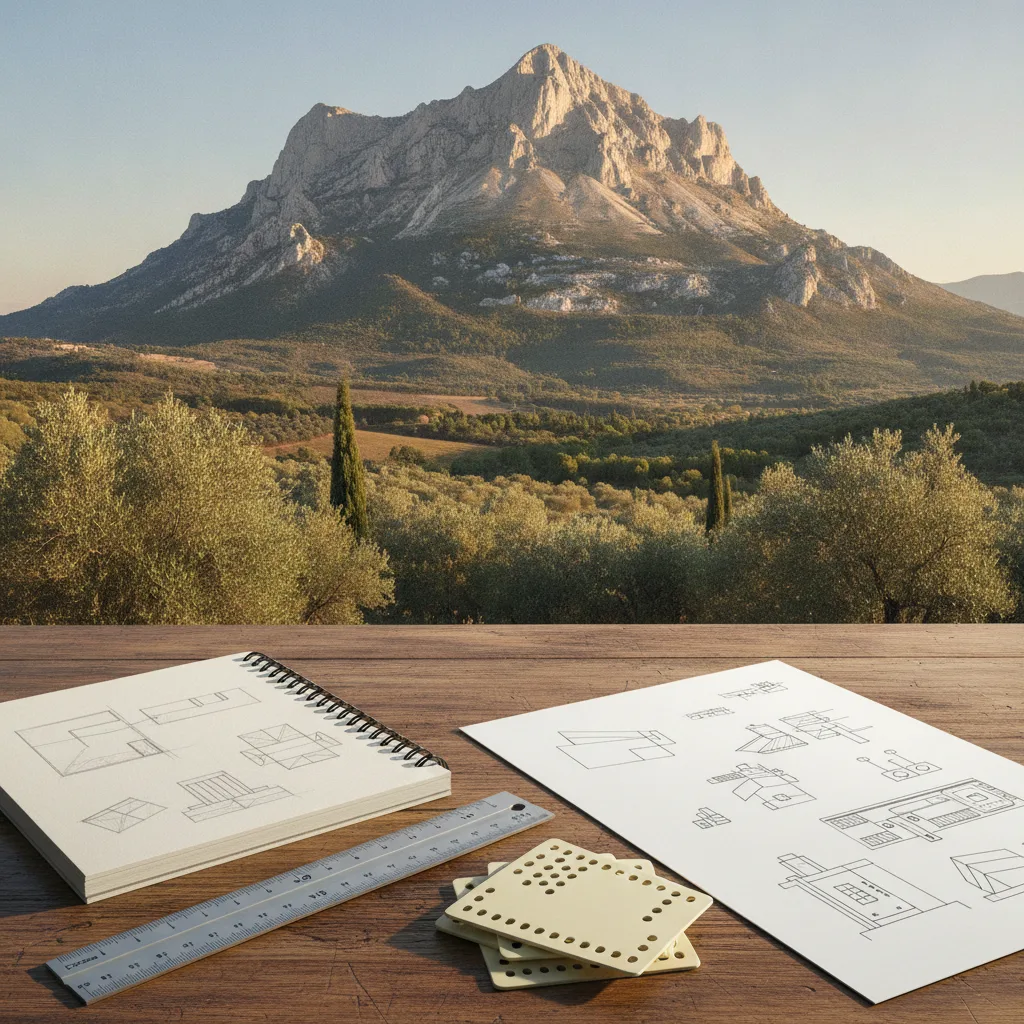
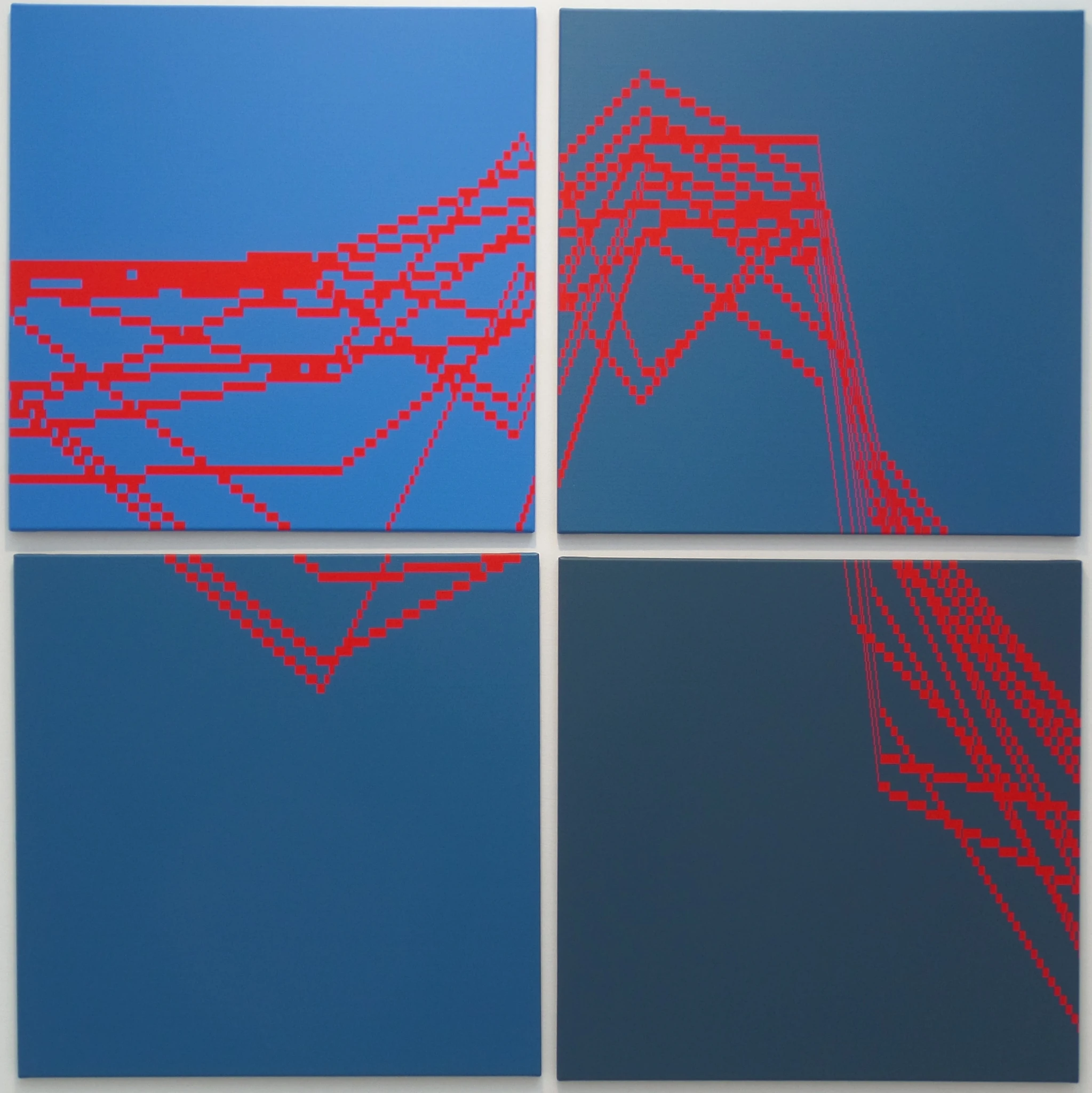
That association explains why the dialogue with Cezanne is not a tribute in the conventional sense. Cezanne broke the mountain into planes and chromatic facets. Molnar breaks it into coordinates, segments and iterations. Where Cezanne repeated the motif to test perception, Molnar repeats it to test the limits of a rule. Both artists use the same mountain as a constant so that everything else can vary. Our quadriptych from the gallery’s holdings, de l’imprimante au pinceau, Sainte-Victoire 1989 to 2015, shows this logic visually, with red lines moving from pixelated to smooth across four panels of progressively deepening blue.
Variations Sainte-Victoire, 1989 to 1996
Variations Sainte-Victoire is the computational heart of the project and the part most frequently cited in histories of digital art, including the SIGGRAPH archive of computer graphics and the Digital Art Museum in Berlin. The principle is accumulation. Molnar starts from a single mountain outline, then lets the number of outlines increase through successive numerical iterations, reportedly up to 2,048 superimposed contours. Early images read as a drawing. Late images read as a dense field of lines in which the mountain dissolves into texture.
The computer here is not a shortcut. It is an instrument for producing controlled differences at a speed and quantity no hand could match, while the artist keeps control of the points, the colours, the density and the stopping rule. A documented example of a printed variation measures about 16.5 by 12 inches. What Molnar exhibits is not a single resolved image but a sequence of states, which is why the series is so often used to explain what generative art actually means in practice.
Good to know
Molnar began working with systematic repetition before she had access to a computer, using what she called her machine imaginaire, a mental algorithm executed by hand. The machine arrived later to accelerate a method that already existed.
Key Works in the Series at a Glance
The table below gathers the main groups and works associated with the Sainte-Victoire motif, with their documented dates, media and defining characteristic. Titles, dates and edition details should always be confirmed against the estate or the representing gallery before any purchase.
| Work or group | Date | Medium or method | Main characteristic |
|---|---|---|---|
| Variations Sainte-Victoire | 1989 to 1996 | Computer generated prints | Progressive accumulation of mountain outlines, up to 2,048 |
| Sainte-Victoire Blues | 1997 | Torn and assembled blue paper | Chance, fragmentation, collage of the contour |
| Courbe de Sainte-Victoire | 2001 | Painting on canvas, 50 x 50 cm for Courbe 4 | The profile translated into a single curve |
| Sainte-Victoire aux 4 couleurs | 2001 | Coloured pencil on paper | Small format chromatic study |
| Sainte-Victoire Border Line | 2018 | Pigment print on 310 g Canson paper, 150 x 50 cm, edition of 8 plus 4 artist’s copies | Outline built from short horizontal segments |
| Sainte-Victoire en rouge | 2019 | Acrylic on canvas, 100 x 100 cm | Geometric and chromatic treatment in a square format |
Sainte-Victoire Border Line and Variations, Two Different Logics
Readers often ask how Sainte-Victoire Border Line differs from Variations Sainte-Victoire. The distinction is both technical and conceptual. Variations is a cumulative series produced from 1989 onward, in which the same outline is repeated an increasing number of times until the image saturates. Border Line is a single later statement, dated 2018, printed with pigment on 310 g Canson paper at 150 by 50 cm, in an edition of eight copies plus four artist’s copies. Instead of multiplying the contour, Molnar deconstructs it into short horizontal segments, so the mountain exists only as an interrupted border between two zones.
In commercial terms the difference matters as much as the visual one. Variations belongs to the pioneer era of computer art, while Border Line is a late edition print produced with contemporary digital printing. Both are legitimate entry points, but they occupy different positions in the artist’s chronology and in the market.
Chance, Rules and Controlled Randomness
Controlled randomness in Sainte-Victoire works
Molnar’s systems are never closed. The procedure sets the framework, then a deliberate disturbance is introduced. Sainte-Victoire Blues is the clearest illustration. Molnar tore sheets of blue paper without looking at them, then assembled the fragments while consulting a reproduction of Cezanne’s mountain. The algorithm has been replaced by the hand, but the method is identical, which is to generate a population of similar forms and then select, arrange and judge.
This is what specialists mean by controlled randomness. The artist defines the parameters, allows a margin of unpredictability inside them, and reserves the final decision. It explains why two works from the same computational procedure can feel completely different, and why Molnar always refused the idea that the machine was making the art. The machine proposes, the artist disposes.
Is the Series Digital Art or Painting?
Both, and the ambiguity is deliberate. Variations Sainte-Victoire is computer generated or computer assisted, which places it squarely in the history of 1960s and 1970s computer art and its later developments. Sainte-Victoire en rouge is acrylic on canvas measuring 100 by 100 cm, shown in museum exhibitions devoted to her use of the square. Courbe de Sainte-Victoire works are paintings on canvas. Sainte-Victoire aux 4 couleurs is coloured pencil on paper. The series therefore moves freely between plotter drawing, edition print and handmade painting, which is why cataloguing a Molnar work requires precision about medium, support and edition.
Important
For any Sainte-Victoire work, always check whether the stated dimensions refer to the sheet or to the image, and whether the edition number, signature and certificate are documented. These details determine both authenticity and value.
Why Vera Molnar Is Considered a Pioneer of Computer Art
Molnar used computers from the late 1960s, at a time when access meant research laboratories, mainframes and plotters rather than personal machines. She wrote her own procedures, including the program known as Molnart, and used the machine to explore variation systematically instead of producing a single finished picture. Her work is held and documented by institutions and archives dedicated to digital art history, and her influence runs directly into today’s generative art scene, where artists work with code, seeds and iterations exactly as she did with punch cards.
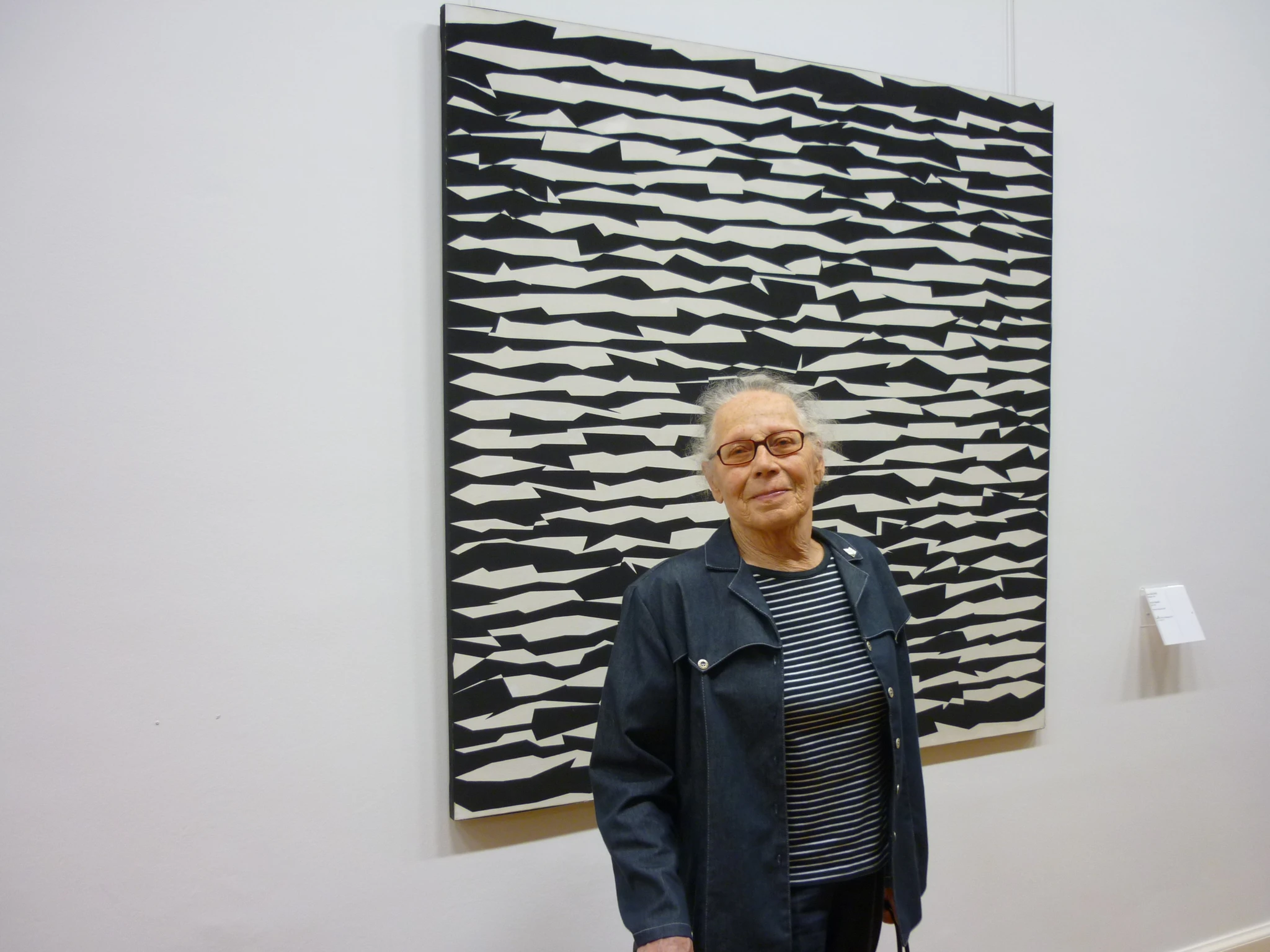
The Sainte-Victoire group is strategic in that story because it connects the newest tool of her time with the most canonical subject of French modern painting. It proves that algorithmic art was never an isolated technical experiment but a continuation of a long pictorial tradition.
Collecting Works From the Series
Key considerations for collectors
For collectors, the appeal is threefold:
An art historical reference that any audience recognises
A technical innovation that situates the work in digital art history
A visual clarity that suits architectural interiors
The series also exists across several media and formats, from works on paper and edition prints to paintings on canvas, which opens different entry points. Before acquiring a work from this body of work, we recommend verifying the following elements, all of which we document for the pieces we handle.
Exact title, date, medium and support, with dimensions specified as sheet or image
Edition size, edition number or artist’s proof status, signature and certificate of authenticity
Provenance, exhibition history and condition report, together with framing, shipping and insurance terms for international delivery
Oniris has shown Vera Molnar regularly over four decades, including the solo exhibitions Vera Molnar, la ligne n’a pas de fin, Alchimie des lignes and Signature VM. Her work is also presented at Art Basel Zero10 Basel 2026. Since our gallery manages the artist’s studio archive and Mr. Florent Paumelle holds the moral and economic rights to Vera Molnar’s entire body of work, the documentation comes directly from the source, and our team will respond to you personally in English.
Beyond the Mountain: Why the Series Still Matters
The Sainte-Victoire works are best read as a sustained investigation into how a historically loaded landscape can be translated into computational and geometric language. Cezanne used the mountain to test how the eye assembles a world. Molnar used it to test how a rule behaves when it is repeated two thousand times.
Between the two, a line travels from oil paint to plotter and back to acrylic, losing its descriptive function and gaining a structural one. That journey is what makes this series essential for anyone interested in geometric abstraction, generative art and the moment when code entered the studio.
Frequently Asked Questions
Did Vera Molnar ever see Mont Sainte-Victoire in person?
She discovered the motif through reproductions of Cezanne’s paintings during her studies in Budapest, and that mediated encounter remained central to how she treated the subject. The mountain functioned for her as an image inherited from painting as much as a place in Provence.
How should a Sainte-Victoire print be stored and displayed?
Works on paper, including pigment prints, should be framed under UV filtering glazing, mounted with acid free materials, and kept away from direct sunlight and humidity variations. Stable room conditions matter more than any single precaution.
Are there other artists at Oniris working in the same geometric lineage?
Yes. The gallery represents or has shown figures such as Francois Morellet, Aurelie Nemours, Ode Bertrand and Norman Dilworth, all working with systems, modular structures and geometric abstraction, which makes them natural companions to Molnar in a collection.
What is the difference between a plotter drawing and a pigment print?
A plotter drawing is executed by a mechanical arm holding a pen that physically traces lines on paper following instructions from a program. A pigment print is produced by an inkjet process depositing pigmented ink, typically on heavyweight fine art paper such as 310 g Canson.
Can Oniris help researchers requesting archives or image rights?
Yes. We handle requests from universities, curators and publishers regarding archives, exhibition histories and reproduction rights, and we ship catalogues and artist books internationally.